Products
Use cases
Industries
Resources
Company
.png)

.png)






.svg)
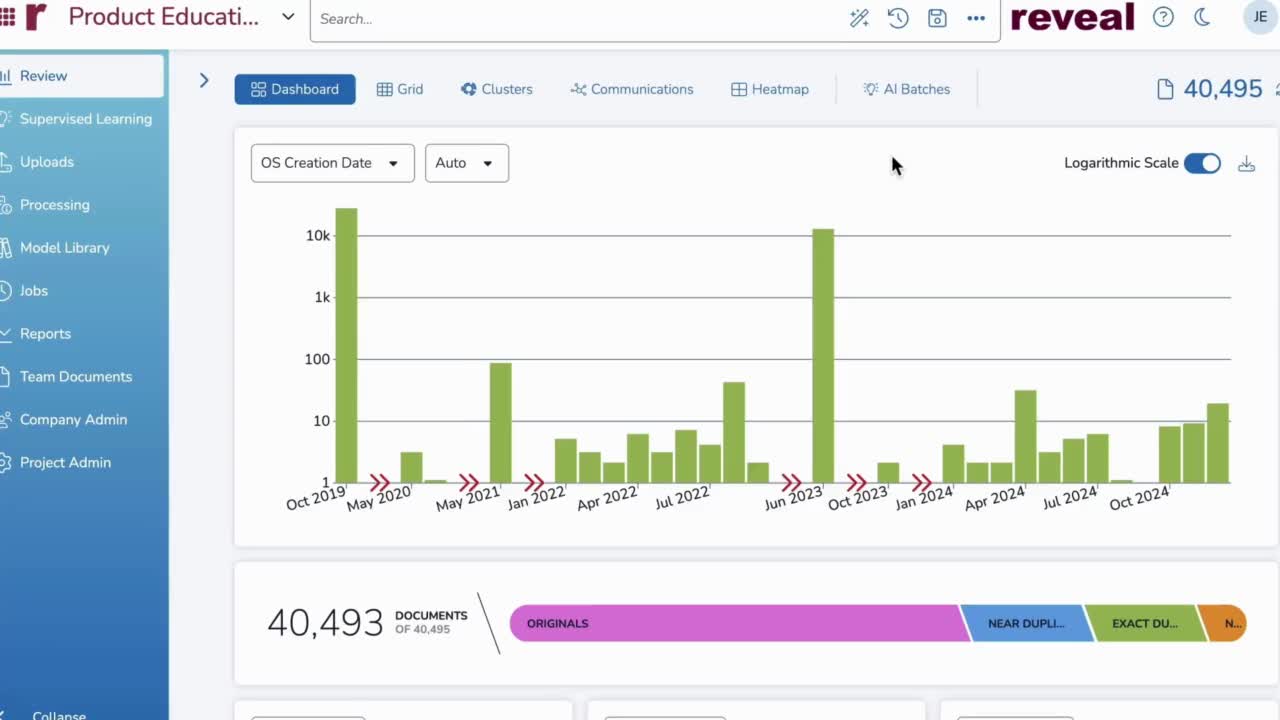
Applies generative AI to first-level document review with subject matter expert relevance guidance. Provides transparent reasoning and citations for every determination, so legal teams can stand behind AI-generated review decisions in court. Up to 90% reduction in first-level manual review volume. Operates in full GenAI mode or a hybrid mode combining GenAI with supervised machine learning for faster, more cost-efficient results at scale.
.png)
Pose investigative questions in natural language. Receive precise, cited answers drawn from the document corpus—with ranked source documents, direct links, and text snippets showing exactly where answers originated. No Boolean query construction. No keyword guessing. Results can be saved as searches, combined with AI model outputs, and incorporated into review workflows.

Twelve patented technologies that automatically organize document collections into lexically similar clusters, extract entity networks, map communication patterns, and surface thematic structures—without any user configuration or initial query. Investigators can explore the full data landscape from the moment data is loaded. Interactive timeline graphs, entity extraction modals, and sentiment analysis charts surface relevant content in minutes, not weeks.

Dozens of domain-specific classifiers covering contracts, privilege, threatening behavior, harassment, sentiment, and regulatory risk indicators. Apply them to any dataset before review begins. Build and reuse custom models for recurring matter types to preserve decision IP and cut investigation time by up to 50%.

Surfaces high-risk communications by identifying emotionally charged or negative language—urgency, frustration, hostility—enabling review prioritization based on tone rather than keyword matches alone. Particularly valuable in investigations involving employee misconduct, where the most significant documents rarely contain the obvious keywords traditional search strategies target.


Relativity is sunsetting Server for new matters in January 2028. Organizations that haven't completed migration by then face a platform that cannot onboard new cases, investigations, or regulatory inquiries. RPD is the planned, controlled path forward.
RPD is not a managed hosting arrangement. Clients retain full control over data residency, network topology, access controls, and security configurations. RPD supports sovereign and air-gapped environments, government-accredited cloud frameworks, and client-mandated data isolation requirements.
AWS commercial or GovCloud, Microsoft Azure, private cloud, hybrid configurations, or bare-metal hardware - RPD supports all of them without any modification to platform functionality. Matters can move between RPD and Reveal SaaS without loss of data, workflow states, or analytical outputs.

RPD delivers capabilities Relativity Server has never offered and will never offer: GenAI-powered first-pass review via aji, conversational natural-language search via Ask, patented visual clustering and analytics, pre-built AI model classifiers, and sentiment analysis. All native to RPD and all included.
If your clients require data isolation, your cross-border matters trigger regulatory constraints, or the economics of a multi-tenant SaaS model don't work for your practice, RPD was built for exactly your situation.
Reveal stages 1 TB in 5 hours vs. 10 hours for the leading competitor. Processing runs at 6 hours per TB vs. 10 hours. Document-to-document review navigation averages 0.5 seconds vs. 2 seconds. Productions of 50,000 pages take 30 minutes vs. 1 hour. These aren't just incidental benchmarks, they translate directly into reduced review timelines and lower staffing costs.

Reveal's dedicated Case Migration Team manages data and case migration, workflow translation, and user transition end-to-end. Experienced Relativity users can onboard in under one hour. Enterprise support runs 24×7 with P1 critical issue response targets of 2 hours.
Reveal Private Deployments follow a structured 5-phase implementation methodology
designed to minimize time-to-value and eliminate the configuration risk that has
historically been a barrier to private deployment adoption.
Infrastructure, security, and legal tech teams align on architecture, storage sizing, network configuration, and migration scope.
Kubernetes cluster, network environment, storage volumes, and database instances provisioned using Reveal's Terraform-based infrastructure-as-code templates.
Coding layouts, tag structures, production templates, user provisioning, and role-based access control configured. Performance validated against agreed benchmarks.
Role-based training for administrators, case managers, and reviewers via Reveal Academy. Experienced Relativity users: under one hour.
First matters onboarded under close monitoring. Weekly launch calls, infrastructure pulse checks, and workflow alignment through Reveal's 90-Day Launch Control Model.
Reduction in first-level manual review.
Reveal's GenAI engine aji can eliminate the majority of linear review, the single largest cost driver in most matters.
Reduction in investigative analysis time.
Pre-built AI model classifiers cull low-value documents and surface high-priority material before a single reviewer touches the collection.
Faster processing and staging vs. leading competitor. Auto-scaling dedicated processing agents eliminate shared queues and the wait times they generate.
The complete side-by-side breakdown of AI capabilities, processing performance, deployment flexibility, and total cost of ownership of Reveal Private Deployment and Relativity Server.
This whitepaper gives your IT, legal technology, and operations teams everything they need to assess Reveal Private Deployment and why it is the go-to Relativity Server alternative.
.svg)
.png)
RelativityOne's consumption-based pricing scales directly with data volumes and user activity. In environments where data volumes grow consistently year over year, that's no longer just a cost model, it's compounding financial exposure.
RPD operates on a predictable licensing model that doesn't escalate with data consumption. For organizations processing at enterprise-sized scale, the crossover point at which RPD's total cost is lower than RelativityOne's consumption-based pricing is often reached within the first year.
Infrastructure costs in RPD are controllable and optimizable. For firms delivering eDiscovery services to clients, they're directly allocable to matters, converting what would be an absorbed vendor overhead on RelativityOne into a recoverable cost on RPD.
And the AI efficiency gains are where the ROI case becomes compelling: first-pass review automation via aji can reduce first-level manual review requirements by up to 90%, directly reducing the single largest cost component in most matters. For organizations processing tens of millions of documents annually, that efficiency gain can, in many cases, fund the entire RPD investment.

Migration from Relativity Server involves three workstreams: data and case migration, workflow translation, and user transition. Reveal's dedicated Case Migration Team manages all three.
Historical coding decisions, the decision IP organizations have built up over years of Relativity use, are preserved and mapped to equivalent structures in Reveal. Standard eDiscovery workflows including processing, review, production, and legal hold map directly to Reveal functionality. Custom integrations with matter management platforms, billing systems, and document management environments are addressed through Reveal's API layer.
Reveal also supports a phased archival migration strategy. Active and recently active matters migrate first, while historical archives follow on a structured timeline. No all-or-nothing dependency that delays go-live dates.
.png)
.png)
.png)

.png)